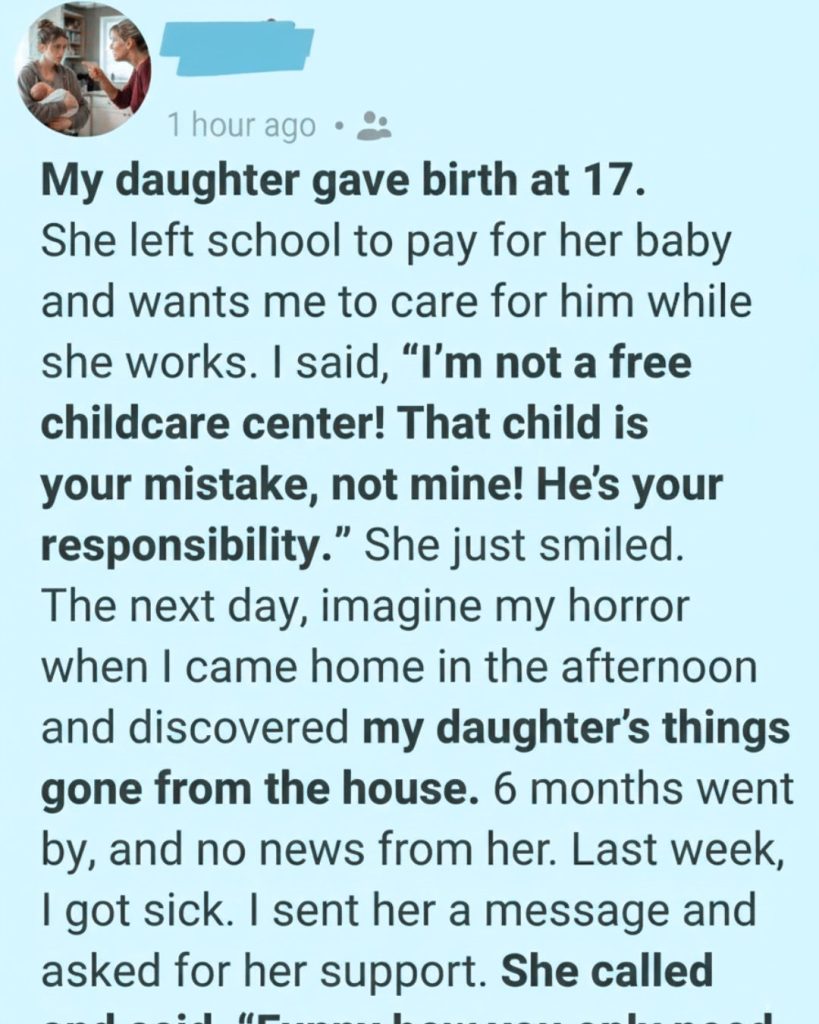

I used to believe that one sentence could never destroy an entire family, until the day my daughter stood in my kitchen holding her newborn son, exhausted, shaking, barely seventeen years old, and asked me for help — and I answered her with cruelty disguised as strength.
She had dark circles under her eyes, milk stains on her shirt, and the kind of fear in her gaze that only comes from realizing you are suddenly responsible for another human life before you’ve even figured out your own.
“I’m going to drop out for now,” she said quietly. “I’ll find work. I just need you to watch him while I do. Just for a little while. I promise I’ll get back on my feet.”
But instead of hearing desperation, instead of hearing a child begging her mother for a lifeline, I heard something ugly inside myself — resentment.
Years of sacrifice exploded inside my chest.
Years of being a single mother.
Years of missed dreams, missed sleep, missed chances at a life I never got to live.
And in that moment, I didn’t see my daughter.
I saw another burden.
So I said the words that still echo in my nightmares.

“I’m not your free babysitter. That baby is your mistake, not mine. You chose this. You deal with it.”
She didn’t scream.
She didn’t beg.
She didn’t cry.
She just smiled — a small, broken smile — and nodded.
And that smile was the sound of our family breaking.
The next day, I came home to a house that felt hollow, like the air had been sucked out of it. Her shoes were gone. Her clothes were gone. The baby’s blanket, the bottles, the tiny socks — all gone.
On the kitchen table was a single letter.
“You’re right, Mom. He’s MY responsibility. So I’m leaving. Since you made it clear you want nothing to do with your grandson, I’ll make sure you don’t. No visits. No calls. No pictures. You wanted boundaries — here they are.”
I read it again and again until the words lost their shape, until I finally understood what I had done.
But pride kept me silent.
Weeks passed.
Then months.
No calls.
No messages.
No photos of the baby I had refused before he even learned my name.
At first, I told myself she was bluffing. That life would be too hard. That she would come crawling back. But she didn’t.
And then my body began to betray me.
The fatigue.
The numbness.
The dizziness.
The doctor said it softly, like he was afraid the words themselves might break me:
“Early-stage multiple sclerosis.”
I went home and sat alone in the quiet house I had insisted on keeping, shaking so badly I could barely hold my phone.
That night, I finally messaged her.
I told her I was sick.
I told her I was scared.
I told her I needed her.
She called the next day.
Her voice was steady. Controlled. Almost cold.

“Funny how you only want family when YOU need something,” she said. “That sounds like your responsibility, not mine. I’m not your free nursing home.”
The silence after those words was unbearable.
“I’m your mother,” I whispered.
“And I was your daughter when I asked for help,” she replied.
Then she hung up.
Now I sit here alone, in a house full of ghosts — of her laughter, of the baby I never held, of the moment I chose pride over love — and I wonder if this emptiness is my punishment or simply the mirror of the lesson I taught her.

I thought I was setting boundaries.
I thought I was protecting myself.
But all I really did was teach my daughter how to walk away from someone who refuses to show up.
And now that I finally understand the cost…
I don’t know if forgiveness is still something I’m allowed to ask for.