
When I returned home from a week-long business trip and found my front porch buried beneath a mountain of roses, my first thought was that someone was trying to steal my wife.
I couldn’t have been more wrong.
For seven years, my wife, Jane, had greeted me the same way whenever I came home from traveling for work.
Before I even finished pulling into the driveway, she’d be standing on the porch waiting for me. Sometimes she’d wave excitedly with both hands. Sometimes she’d be wrapped in one of my oversized sweaters, coffee mug in hand, smiling as though I’d been gone for months instead of a few days.
It was our routine.
So the moment I turned onto our street and saw the porch empty, something felt off.
I slowed the car and looked toward the house.
“Jane?” I muttered.
Then I noticed the flowers.
At first, I assumed there were a few bouquets by the door.
As I got closer, I realized I was very, very wrong.
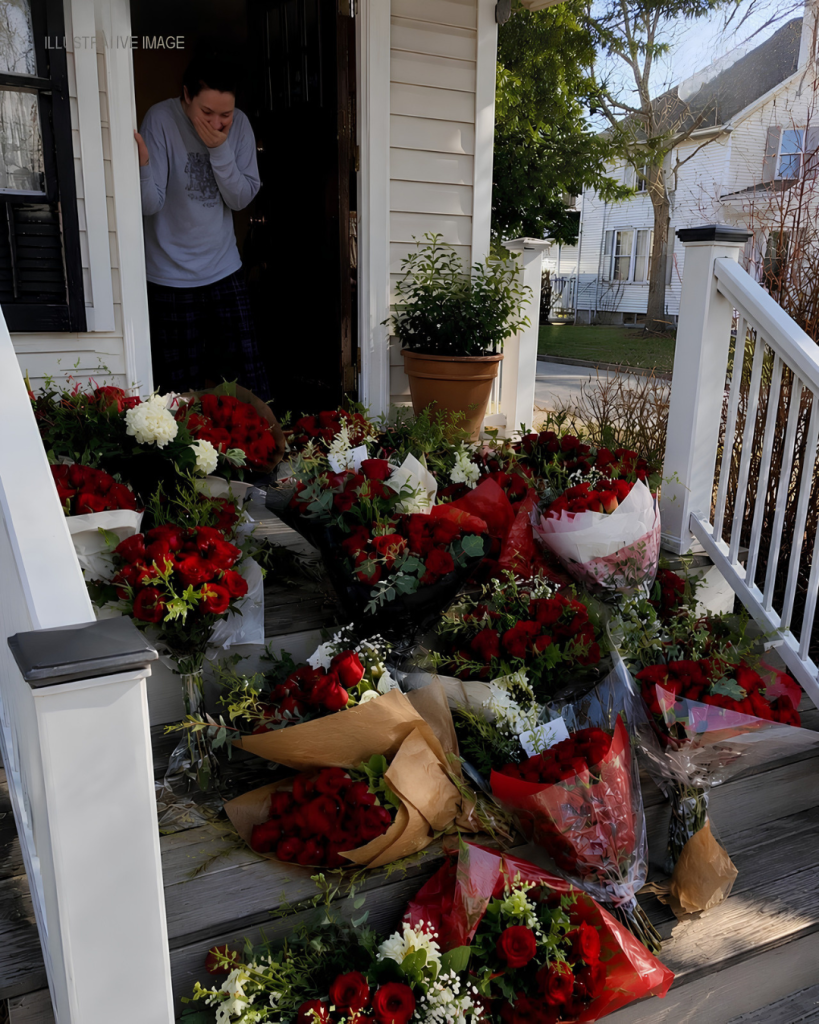
The entire porch was covered in roses.
Red roses. Pink roses. White roses. Yellow roses.
They were stacked against the railing, lined up along the porch swing, and clustered around the front steps. There were so many flowers that parts of the porch floor weren’t even visible anymore.
I parked abruptly and climbed out of the car.
“What in the world…”
The scent hit me instantly—sweet, heavy, and overwhelming.
This should have looked romantic.
Instead, it made my stomach knot.
Who sends a married woman this many flowers?
And why?
The front door opened before I could process another thought.
Jane stepped outside.
The moment she saw me, her face lit up.
Then she noticed the flowers.
Her smile vanished.
“Mark,” she said. “What did you do?”
I stared at her.
“What did I do?”
She looked around the porch in confusion.
“You didn’t send these?”
“No.”
A pause.
“I just got home.”
The color drained slightly from her face.
“Then who did?”
The question hung between us.
I tried to laugh.
It sounded forced.
“I was hoping you could tell me.”
Jane folded her arms across her chest.
“Mark…”
I hated myself for it, but suspicion had already started creeping into my mind.
A hundred roses don’t just appear out of nowhere.
She saw the doubt in my expression immediately.
Her eyes filled with hurt.
“You think someone secretly sent me all of this?”
“I don’t know what to think.”
She took a step backward.
For a moment, neither of us spoke.
Then something caught my eye.
A small white envelope was tucked into one of the bouquets near the porch swing.
I bent down and picked it up.
No name.
No return address.
Just a hand-drawn heart in blue marker.
Jane stood beside me as I carefully opened it.
Inside was a folded note.
I unfolded the paper and began reading.
The first sentence stopped me cold.
“Please don’t quit.”
Jane inhaled sharply.
I continued.
“We love you so much.”
My voice softened.
Then I read the final line.
“We are so sorry.”
Silence.
Jane covered her mouth.
“No,” she whispered.
She grabbed the note from my hands and read it herself.
Within seconds, tears filled her eyes.
Not gentle tears.
Not the kind people politely wipe away.
These were tears that had been building for months.
She began crying so hard that I immediately wrapped my arms around her.
“Jane, what’s going on?”
For a moment she couldn’t answer.
She simply stood there shaking against my chest.
When she finally looked up, she wasn’t staring at me.
She was staring at the flowers.
That’s when I noticed something.
Nearly every bouquet had a small card attached.
Some were decorated with stickers.
Others had colorful handwriting.
Many were signed by children.
My confusion disappeared.
These weren’t romantic gifts.
They were thank-you gifts.
“They’re from your students,” I said softly.
Jane nodded.
And suddenly everything made sense.
For months, I’d watched my wife struggle.
Teaching wasn’t simply her job.
It was her passion.
She spent evenings grading papers long after dinner.
She bought supplies for her classroom with her own money.
She remembered birthdays, learning styles, favorite books, and personal challenges for every student she taught.
She cared more than anyone I knew.
But this year had been different.
Every day seemed to leave her a little more exhausted.
I remembered finding her at the kitchen table one night, staring at a stack of assignments.
She looked completely drained.
“I don’t know if I can keep doing this anymore,” she admitted.
Another evening, I found her awake after midnight.
She sat in front of her laptop, eyes red from crying.
“Why aren’t you sleeping?” I asked.
She sighed.
“Because tomorrow I have to walk into that classroom and pretend everything is fine.”
I sat beside her.
“You don’t have to pretend.”
She shook her head.
“Yes, I do.”
Then came the confession that broke my heart.
“I feel like I’m failing.”
She wasn’t.
Not even close.
But stress has a way of convincing good people otherwise.
The constant pressure.
The endless workload.
The feeling that no matter how much effort you give, it still isn’t enough.
A few weeks before my trip, she’d reached her breaking point.
I remembered standing in the kitchen while she typed a message to the parents of her students.
She stared at the screen for nearly ten minutes before finally hitting send.
“What did you write?” I asked.
She swallowed hard.
“The truth.”
In the message, she admitted she was exhausted.
She explained how much she loved teaching but confessed she wasn’t sure how much longer she could continue if things didn’t improve.
Almost immediately, she regretted sending it.
“I shouldn’t have said anything.”
“Why not?”
“Because teachers aren’t supposed to admit they’re struggling.”
Standing on our porch now, surrounded by hundreds of roses, I realized something.
The parents had read every word.
And they had listened.
Jane picked up another card.
Her voice trembled as she read.
“Thank you for helping Ethan believe in himself.”
Then another.
“Thank you for never giving up on Sophia.”
Another.
“Thank you for making school feel safe.”
And another.
“You changed our son’s life.”
The messages kept coming.
Every card told a different story.
Yet they all carried the same message:
You matter.
Soon we were both sitting on the porch steps, surrounded by flowers, reading note after note.
One card simply said:
“You’re my favorite teacher.”
Another read:
“School is better because you’re there.”
Then Jane opened a glitter-covered card written in large, crooked letters.
She laughed through her tears.
“Dear Mrs. Jane, please don’t quit because you make math less scary and your jokes are funny even when nobody laughs.”
I laughed.
Jane laughed.
Then she cried all over again.
The deeper we dug into the mountain of bouquets, the more stories we uncovered.
Parents thanked her for encouraging their children.
Students thanked her for believing in them.
Families thanked her for showing kindness during difficult times.
With every card she opened, I watched something slowly return to her.
Hope.
Real hope.
The kind she’d been missing for months.
One note from a parent stopped her completely.
It was from a boy named Tyler.
A student she’d worried about constantly.
The message read:
“Tyler used to cry every morning before school. You are the reason he now loves learning. Thank you for changing his life.”
Jane stared at the card.
“I didn’t know they felt this way.”
I squeezed her hand.
“They noticed.”
She looked around at the sea of flowers.
One hundred bouquets.
One hundred families.
One hundred reminders that her work mattered.
As evening approached, we began carrying the roses inside.
The kitchen filled first.
Then the dining room.
Then the living room.
Every available surface became home to another bouquet.
By the time we finished, the entire house smelled like a garden in full bloom.
Jane stood in the middle of the room turning slowly in a circle.
I hadn’t seen her smile like that in a very long time.
Not the tired smile she’d worn lately.
Not the polite smile she gave strangers.
A genuine smile.
A relieved smile.
A hopeful smile.
Then she spotted one final envelope hidden beneath a bouquet near the fireplace.
Carefully, she opened it.
Inside was a large card covered with signatures.
Students.
Parents.
Entire families.
At the bottom, someone had written a final message:
“The world needs teachers like you. Please don’t give up on us because we haven’t given up on you.”
Jane pressed the card against her chest.
Tears streamed down her face once again.
But these tears were different.
They weren’t born from exhaustion.
They weren’t born from frustration.
They were tears of relief.
For months, I’d watched my wife question herself.
Question her career.
Question whether all the sacrifices were worth it.
Now she finally had her answer.
Teachers rarely get to see the impact they make while they’re making it.
They plant seeds without knowing which ones will grow.
They show up every day without realizing how many lives they’re quietly changing.
Jane rested her head against my shoulder.
“I was really going to quit.”
“I know.”
“I’d already started applying for other jobs.”
I looked around the room overflowing with roses and handwritten notes.
“And now?”
She smiled.
A real smile.
The kind that reaches someone’s eyes.
“I think I need to be at school on Monday.”
I laughed.
“You think?”
She laughed too.
And for the first time in months, the sound filled our home.
Later that night, we sat together on the couch surrounded by roses.
I thought back to the moment I’d first seen the flowers.
For a few terrible minutes, I’d convinced myself they were evidence of betrayal.
Instead, they became something far more meaningful.
They were proof that kindness leaves a mark.
Proof that appreciation often arrives when it’s needed most.
And proof that while my wife spent every day teaching her students, she had unknowingly taught them one of life’s most important lessons:
How to show up for someone who needs to know they are valued.