
More than a year after a tragic confrontation at a Texas track meet claimed the life of 17-year-old Austin Metcalf, his family stood in court and spoke openly about the grief that continues to shape every part of their lives.
While the sentencing of Karmelo Anthony marked a major moment in the long legal process, some of the most emotional moments inside the courtroom came from Austin’s loved ones. Their statements painted a heartbreaking picture of a family still struggling to cope with the sudden loss of a son, a brother, and a future that was taken away far too soon.
As Karmelo sat quietly in court, Austin’s family addressed him directly, describing the pain they have carried since the day Austin died.
The case began on April 2, 2025, during a district track meet at Kuykendall Stadium in Frisco, Texas. Austin Metcalf and Karmelo Anthony, both 17 at the time, attended different schools and reportedly had never met before that morning.
Investigators said an altercation broke out under a team tent shortly before 10 a.m. During the confrontation, authorities said Karmelo stabbed Austin in the chest.
Austin was rushed to a nearby hospital but later died from his injuries.
Two days after the incident, police documents revealed that Karmelo admitted to the stabbing but claimed he acted in self-defense.
Austin was laid to rest on April 12, 2025. Weeks later, Karmelo was released from jail after his bond was reduced from $1 million to $250,000, with conditions that included house arrest.
In June 2025, a grand jury formally indicted him on a murder charge.
The case quickly gained national attention, sparking heated public debate and intense scrutiny online. Both families became the focus of widespread commentary, much of it deeply personal and emotionally charged.
When the trial finally began in June 2026, jurors spent several days reviewing evidence and hearing testimony from witnesses, investigators, and attorneys on both sides.
Ultimately, the jury rejected Karmelo’s claim of self-defense and found him guilty of murder.
Before sentencing was announced, Austin’s family members were given an opportunity to speak directly to the court.
Austin’s mother, Meghan Metcalf, described the devastating reality of living without her son.
She said many of her conversations with Austin now happen while sitting beside his grave. Instead of watching him grow into adulthood, she explained, she now carries him only in memories.
Meghan spoke about walking into Austin’s empty bedroom and reliving the same heartbreak every single day.
She remembered him as a natural peacemaker — someone who loved bringing people together, giving hugs, and making others feel welcome.
But she also spoke about the pain of watching Austin’s twin brother, Hunter, face life without the person who had been beside him since birth.
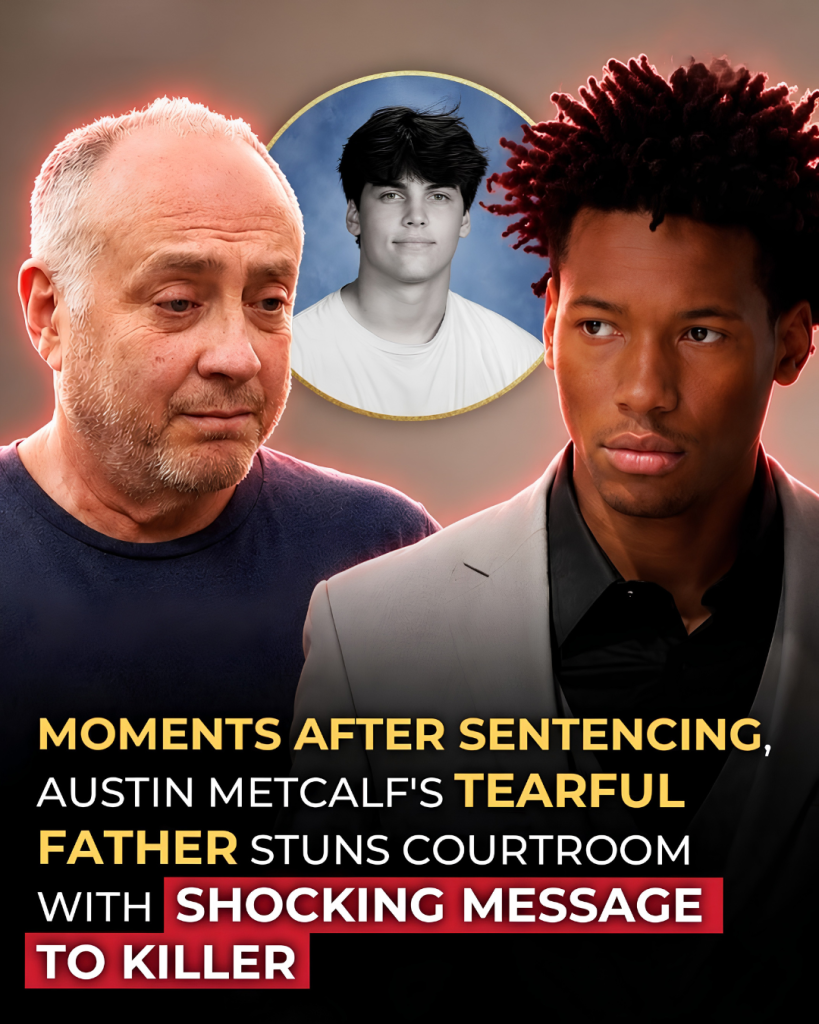
Austin’s father, Jeff Metcalf, delivered an emotional statement filled with both sorrow and anger.
He described Austin as a leader, an athlete, and a young man with enormous promise. Jeff also spoke about creating a scholarship in Austin’s memory so others could continue learning from the example his son set.
At the same time, he acknowledged the rage that has followed him since Austin’s death.
According to Jeff, grief is not just sadness. It is frustration, heartbreak, and the unbearable reality of knowing someone you love was taken away forever.
He also criticized those who attempted to turn the tragedy into a racial controversy and described the harassment his family endured throughout the case, including repeated swatting incidents.
Then, turning directly toward Karmelo, Jeff delivered one of the courtroom’s most powerful moments.
“You can’t even look me in the eye right now, but you can stab my son in the heart.”
The courtroom fell silent.
Jeff ended his statement with a final tribute to Austin, describing him as a young man whose life had touched countless people.
Austin’s twin brother, Hunter Metcalf, then stood before the court.
His statement focused not only on losing a brother, but losing his closest friend.
Hunter spoke about trying to find forgiveness through faith while struggling to understand how his family’s life changed so suddenly.
He talked about the milestones Austin will never experience — future birthdays, graduations, weddings, and the possibility of one day becoming an uncle.
Addressing Karmelo directly, Hunter said he believed evil took control in that moment.
Still, he expressed confidence that Austin’s memory would continue to live on long after public attention surrounding the case fades away.
Austin’s aunt, Marlee Needham, also shared emotional memories of her nephew, describing him as someone deeply devoted to his family and especially caring toward younger relatives.
She acknowledged that faith has helped the family endure the tragedy, but admitted it has not removed the pain.
Even after the trial, the testimony, and the verdict, one painful question still lingers for many members of the family:
Why?
It is a question they may never fully answer.
After less than three hours of deliberation, jurors convicted Karmelo Anthony of murder.
They later rejected the defense’s argument that the killing occurred under Texas’ “sudden passion” standard, which could have reduced the possible punishment.
The jury ultimately sentenced Karmelo to 35 years in prison.
Under Texas law, he must serve at least half of that sentence before becoming eligible for parole.
As the hearing came to an end, Austin’s family made it clear that while the verdict brought accountability, it could never bring closure.
No sentence, they said, can restore the life they lost.
And although the legal proceedings may now be over, the absence of Austin Metcalf is something his family will carry with them for the rest of their lives.