
I was twenty-two years old, exhausted, and completely out of options.
By day, I attended college classes. At night, I stocked shelves at a grocery store until my feet ached so badly I could barely walk home. Whatever time remained belonged to my family — especially my younger brother, Noah.
Noah was only fourteen, yet hospitals had become more familiar to him than classrooms. Treatments, medications, specialists… the costs never stopped growing.
Far faster than we could keep up.
My mother tried to stay strong through it all. She worked endless double shifts as a nurse’s aide and still somehow managed to smile whenever Noah looked scared.
But I saw what she hid from everyone else.
I saw the unpaid bills piling up on the kitchen table.
I saw her sitting alone after midnight with tears silently running down her face.
I saw the fear she tried so desperately to bury.
One rainy Thursday evening, another hospital bill arrived.
My mother stared at the number for a very long time before quietly folding the paper and sliding it beneath the others.
For the first time in my life, I saw defeat in her eyes.
And that terrified me.
That night, after everyone had gone to sleep, I opened my laptop and searched for every side job I could possibly find.
Dog walking.
Tutoring.
Cleaning houses.
Anything.
Then one listing caught my attention.
At first, I honestly thought it was fake.
“Seeking young woman, approximately age 20–25, to spend Sundays with elderly blind veteran. Generous compensation. Must be comfortable acting as family companion.”
I reread the ad several times.
The pay alone was almost three times my weekly grocery store salary.
Then I continued reading.
The elderly man’s granddaughter no longer visited him. His family wanted him to feel loved and connected during his remaining years. The applicant would essentially step into the role of a granddaughter.
I stared at the screen.
It felt wrong.
Dishonest.
Cruel, even.
I nearly closed the page.
But then I looked at the hospital bill beside my laptop.
And I applied.
A week later, I found myself sitting across from a tired-looking woman named Linda.
“He lost his eyesight six years ago,” she explained softly. “His name is Walter Harrison. He’s a veteran. Proud. Stubborn. And lonelier than he’ll ever admit.”
She hesitated before continuing.
“My daughter stopped visiting after a family fallout years ago. But Dad still asks about her.”
The silence between us felt painfully heavy.
“I know this arrangement sounds strange,” Linda admitted, lowering her eyes. “But I can’t bear the thought of him spending his final years believing he’s been abandoned.”
I swallowed hard.
“What exactly would I need to do?”
“Just spend Sundays with him,” she said. “Talk. Eat lunch together. Listen to his stories.”
“And pretend to be his granddaughter?”
Linda nodded slowly.
“Yes.”
The answer settled heavily in my chest.
But I still accepted.
The first Sunday was unbearable.
I spent the entire drive rehearsing fake conversations in my head.
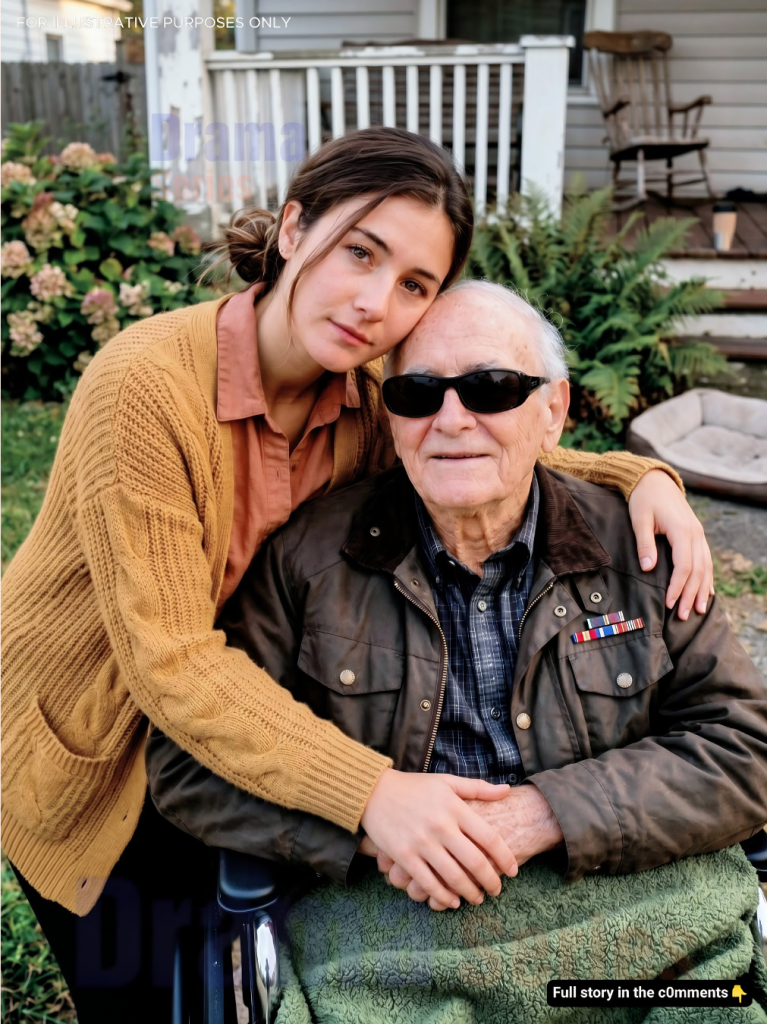
Walter lived in a small white house surrounded by flower beds and towering oak trees. The moment I knocked, the door opened almost immediately.
Even though he couldn’t see me, he smiled warmly.
“There you are.”
My stomach twisted.
“Hi… Grandpa.”
The word felt unnatural. Like I was stealing a place that didn’t belong to me.
But Walter simply reached out his hand.
“Come inside.”
That first visit lasted nearly four hours.
Walter did most of the talking.
He told stories about serving in the military. About repairing trucks in his younger days. About fishing trips with old friends.
And most of all, he talked about his wife, Margaret.
Whenever he mentioned her, his voice softened.
“Margaret could make anybody laugh,” he said with a quiet smile. “Even me.”
Without realizing it, I found myself smiling too.
For the first time all day, I forgot I was supposed to be pretending.
The Sundays continued.
Weeks slowly turned into months.
And somewhere along the way, something changed.
Walter stopped feeling like a job.
He became someone I genuinely cared about.
He remembered every detail about my life — my exams, my mother’s exhaustion, Noah’s treatments.
One afternoon, he suddenly asked, “How’s your brother doing?”
I froze.
Then I remembered.
I’d told him everything.
Not because I was required to.
Because I trusted him.
“He’s having a rough week,” I admitted quietly.
Walter squeezed my hand gently.
“He’s lucky to have you.”
Those five words nearly broke me.
As time passed, I started visiting even when I wasn’t being paid.
Sometimes I brought homemade cookies.
Sometimes we simply sat on the porch in silence listening to birdsong drifting through the trees.
Eventually, the lie disappeared entirely.
I wasn’t replacing his granddaughter.
And Walter wasn’t replacing my grandfather.
But somehow, we became family anyway.
Then one Sunday, I arrived and immediately sensed something was wrong.
Walter sounded weaker.
His breathing was slower.
“You okay?” I asked softly.
He chuckled faintly.
“Getting old isn’t for cowards.”
I forced a smile, but fear settled deep inside me.
Over the following months, his health declined quickly.
Hospital visits became constant.
Walking became difficult.
Then impossible.
But every Sunday, he still wanted me there.
One afternoon, while I adjusted his blanket, he reached for my hand.
“You know something?” he whispered.
“What?”
“You changed my final years.”
My eyes filled instantly.
“No, Walter,” I whispered back. “You changed mine.”
He smiled softly.
Neither of us said another word.
We didn’t need to.
Three weeks later, Linda called me.
Before she even spoke, I already knew.
“He’s gone.”
The world suddenly felt unbearably quiet.
I sat on my bed and cried for hours.
Not because I had lost a paycheck.
Because I had lost family.
Walter’s funeral was held the following week.
Veterans attended.
Neighbors attended.
Old friends shared stories about his kindness, his loyalty, his generosity.
Every story sounded exactly like the man I had come to love.
After the service, Linda hugged me tightly.
“Dad adored you,” she whispered.
I couldn’t even answer.
A week later, I received a phone call from Attorney James Whitaker.
“There is a matter concerning Mr. Harrison’s estate,” he explained.
My stomach immediately dropped.
“I think you have the wrong person.”
“I assure you,” he replied carefully, “I do not.”
He paused.
“Mr. Harrison specifically requested your presence.”
The following Friday, I arrived at the lawyer’s office.
The waiting room was crowded with relatives.
Some looked confused.
Others looked openly irritated.
The moment I entered, whispers spread across the room.
“That’s her.”
“The fake granddaughter.”
“What is she doing here?”
I wanted to disappear.
Eventually everyone gathered inside the conference room while Attorney Whitaker opened a thick folder.
The room fell silent.
After reviewing several papers, he finally looked directly at me.
“Before Walter Harrison passed away, he left one final instruction regarding Miss Emily Carter.”
My heart nearly stopped.
Everyone turned toward me.
Whitaker adjusted his glasses and began reading.
“To my family:
Many of you may be surprised to see Emily here today.
And yes, I knew from the very beginning that she was not my biological granddaughter.”
The room erupted with shocked gasps.
Linda’s eyes widened.
Someone dropped a pen.
Whitaker continued reading.
“Blindness does not make a man foolish.
The moment Emily walked into my house, I recognized a different voice. Different footsteps. Different mannerisms.
I knew.”
Tears instantly blurred my vision.
Walter had known all along.
The entire time.
“At first, I allowed the arrangement because I was lonely,” the letter continued. “But after a few weeks, something changed.
Emily stopped pretending.
She became herself.
And that young woman brought more kindness, patience, and love into my life than I ever expected.”
The room remained completely silent.
“Many people may share your blood,” the letter said, “but very few share your heart.
Emily did not continue showing up because she was paid.
She stayed because she cared.
And that distinction matters.”
By then, I was openly crying.
So was Linda.
Then Whitaker read the final instruction.
“I want a portion of my estate placed into a trust dedicated entirely to Noah Carter’s medical treatments and future education.
No child should suffer because their family cannot afford care.
This fund shall be known as The Second Chance Trust.”
The room froze.
I couldn’t breathe.
Whitaker looked directly at me.
“The trust contains two hundred thousand dollars.”
I burst into tears.
Two hundred thousand dollars.
Enough to cover Noah’s treatments.
Enough to give him a future.
Enough to let my mother finally rest.
For the first time in years, we could breathe again.
But there was still one final note.
Whitaker handed me a sealed envelope.
The handwriting on it was unmistakable.
My hands trembled as I opened it.
Emily,
If you’re reading this, then I’m probably somewhere upstairs arguing with angels and telling them old war stories.
Thank you.
Thank you for every Sunday.
Thank you for every conversation.
Thank you for making an old blind man feel like he still mattered.
Family isn’t always about blood.
Sometimes it’s simply about the people who choose to stay.
You chose to stay.
And that made you my granddaughter in every way that truly counts.
Love,
Grandpa Walter.
By the time I finished reading, everyone in the room was crying.
Even the lawyer.
That was three years ago.
Today, Noah is healthy and thriving.
I graduated college.
My mother finally works normal hours again.
And every Sunday, I still drive to Walter’s little white house.
Linda owns the property now, but she always leaves the porch unlocked for me.
I sit in Walter’s favorite rocking chair and tell him about my week.
About Noah.
About life.
And sometimes, when the wind moves softly through the trees, I can almost hear his voice asking the same question he always did.
“How’s your brother doing?”
Every single time, I smile.
Because thanks to one lonely blind veteran who saw more clearly than anyone else ever did, I finally get to answer the way he always hoped I would.
“He’s doing great, Grandpa.”
And somehow…
I think he already knows.