
I always thought my mother survived my father by staying small. I was wrong.
Carol never raised her voice, never fought back in ways I could see. When things got tense, she’d put on her green coat, step outside, and return calm again. I mistook that for weakness. My father, Raymond, built a different story for himself—provider, authority, the one in control.
But the truth was, control was never really his.
I knew he was cheating before everything broke. I had even recorded him once and tried to force the truth into my mother’s hands.
“I don’t need this,” she said calmly, and put the recorder away.
I thought she was avoiding reality. I thought she was choosing humiliation over leaving.
I was wrong about that too.
The breaking point came when my father came home too confident, too careless. My mother was already waiting at the kitchen table.
“Let’s not do drama,” he said.
She replied, steady as ever: “We’re done.”
The next day, she filed for divorce.
I only understood the scale of what she was doing later.
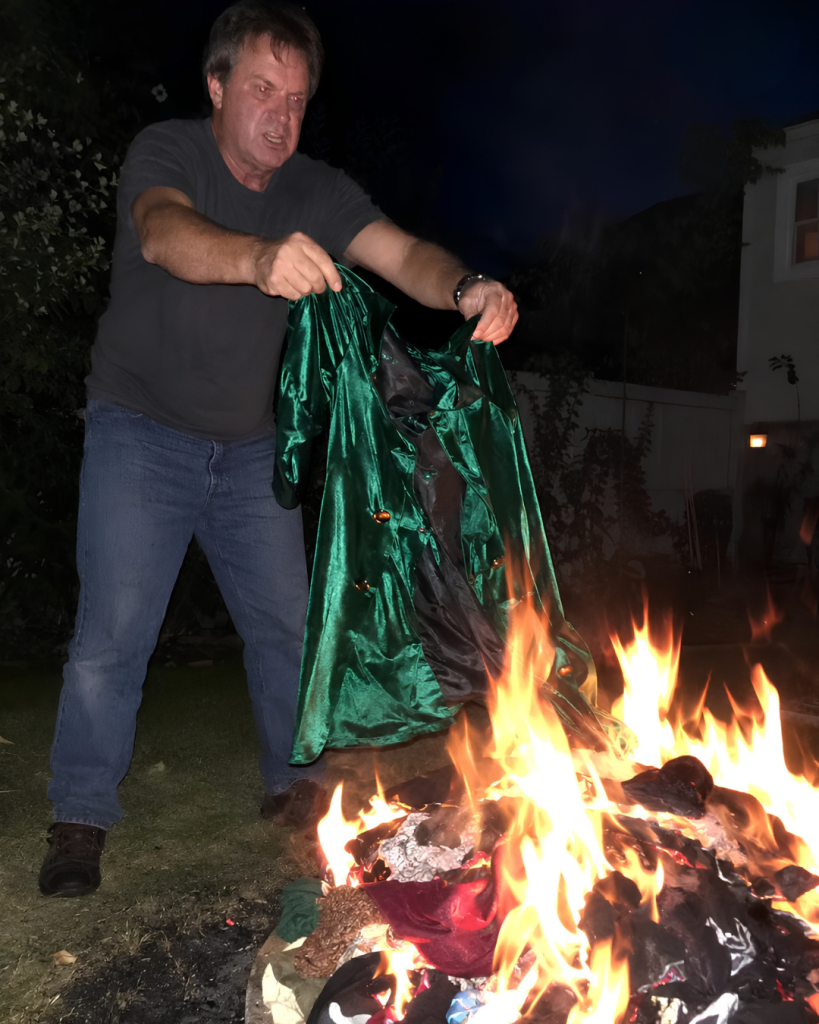
That night, I found my father burning her belongings in the yard—clothes, keepsakes, even her wedding dress.
“She leaves with nothing,” he said.
Then she appeared at the door.
She didn’t scream. She didn’t beg. She just looked at the fire, then at him.
“Okay,” she said quietly. “That’s okay.”
Days later, everything changed.
A package arrived addressed to her. Inside my father found a recorder, documents, transcripts, and proof of conversations, debts, and financial histories he thought were buried. My mother stood in the doorway and said calmly:
“This is the difference between being quiet and being helpless.”
We discovered something else too—records kept by my grandmother. Proof that my mother had saved this family when my father’s business collapsed, using her own money, her inheritance, and years of sacrifice he later erased with a single lie: that she came into his life with nothing.
The truth had been documented all along.
Box after box showed the real story: she paid debts, covered bills, carried the household while he built a version of reality where he was the hero.
When we brought everything home, the house filled with silence—and clarity. My siblings came. We laid the records out. There was no arguing with paper, with timestamps, with receipts.
My father tried to claim it was being twisted.
But it wasn’t.
It was evidence.
By Sunday, he was gone.
No dramatic ending. No final speech. Just departure.
Afterward, the house felt lighter.
I found my mother’s green coat still hanging in the car. The one I thought meant retreat was just preparation.
She put it on, looked in the mirror, and finally smiled.
And I understood then:
My mother was never weak.
She was patient.
And patience, I learned, is not the absence of power—it is the decision to wait until truth can no longer be ignored.