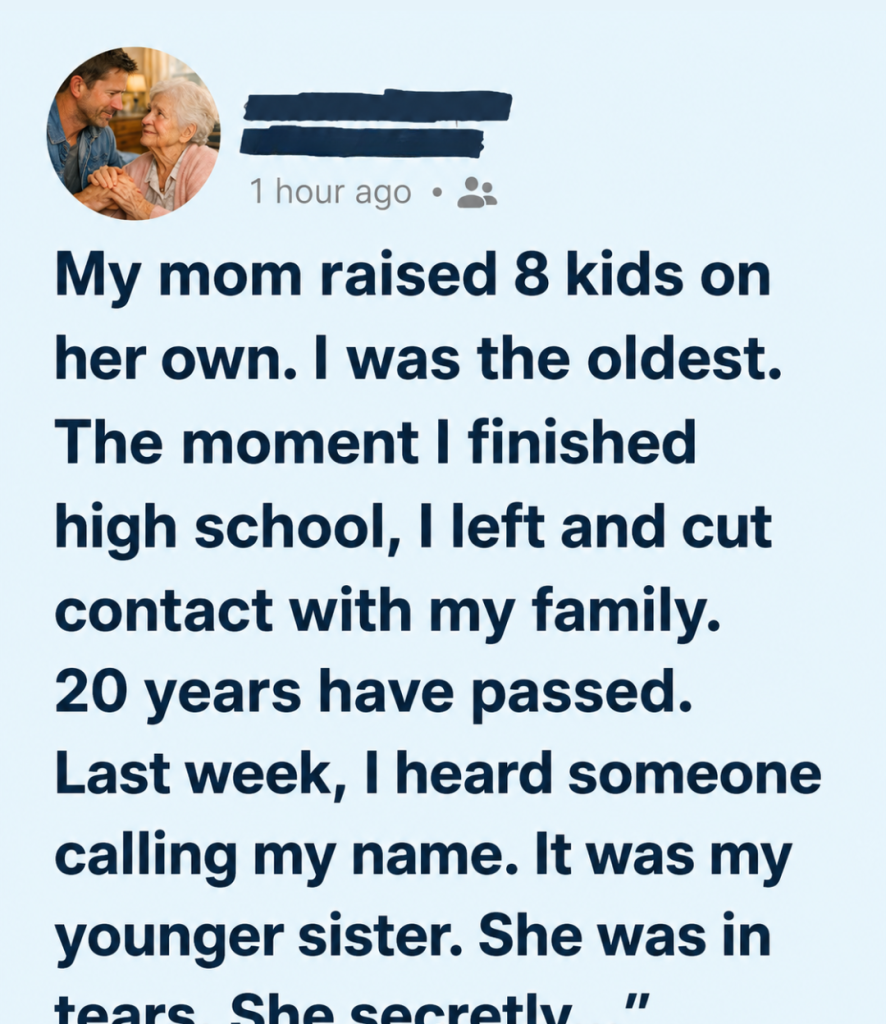

I was eighteen when I left my mother’s house carrying one worn duffel bag, seventy-three dollars, and a heart overflowing with anger I didn’t yet understand.
My father had vanished when I was ten, leaving my mother alone to raise eight children. She worked endless hours—serving customers at a diner during the day and scrubbing office floors late into the night. I remember her cracked hands, rough from bleach and winter air, and the exhaustion that slowly settled into her bones over the years.
And for a long time, I resented her for it.
Not because she was unkind. Not because she failed to love us. But because growing up poor felt suffocating, and I blamed her for every empty refrigerator, every hand-me-down shirt, every moment of embarrassment I carried through childhood.
Being the oldest meant I became another parent before I was even old enough to drive. While other teenagers went to football games or stayed out with friends, I stayed home changing diapers, helping with homework, cooking cheap dinners, and rocking crying babies to sleep. By the time I graduated high school, I felt like my childhood had already been spent raising everyone else.
So the morning after graduation, I left.
I can still picture my mother standing on the porch in her faded blue sweater as I walked away.
“Please call sometimes,” she said quietly.
But I never looked back.
“I need my own life,” I told her. “I can’t keep carrying everyone anymore.”
Then I walked away without turning around.
For years afterward, I convinced myself I’d made the right choice. I worked construction during the day while taking classes at community college at night. Eventually, I earned an engineering degree, built a successful career, bought a condo, then a larger home. I married briefly, divorced quietly, and buried myself in work.
Whenever my siblings reached out, I kept conversations short. Birthdays became quick text messages. Holidays became excuses.
I convinced myself family only held people back.
Twenty years passed like that.
Then, last week, everything changed.
I was leaving a grocery store when I heard someone yelling my name from across the parking lot. At first, I ignored it. But then I heard it again.
“Daniel!”
I turned and saw a woman running toward me with tears streaming down her face. It took me a moment to recognize her.
“Mia?”
My younger sister wrapped her arms around me before I could react. She was shaking as she cried.
“I finally found you,” she whispered.
We sat together in a small café for nearly three hours. At first, we talked about ordinary things—work, children, life. But I could tell something heavier sat beneath her smile.
Finally, she looked at me and asked softly, “Do you know where the money came from?”
I frowned. “What money?”
“The money Aunt Claire sent you for college.”
Confused, I replied, “Aunt Claire helped me because she believed in me.”
Mia stared at me, stunned.
“No,” she said quietly. “Mom sold the house.”
The words knocked the breath out of me.
“What?”
“She sold our house after you left.”
I shook my head automatically. “That can’t be true.”
But Mia nodded through tears.
“After you left, Mom knew you’d never accept help directly from her. You made it clear you didn’t want to owe the family anything. But she still wanted you to have a future.”
I couldn’t speak.
“So she sold the only thing she had left,” Mia continued. “Then she gave the money to Aunt Claire and asked her to send it to you little by little so you’d never know it came from her.”
I stared silently at the table as pieces of the past suddenly began fitting together.
The tuition checks that always arrived on time.
The emergency money that somehow appeared whenever I needed it most.
The way Aunt Claire always avoided talking about finances.
All those years, I believed my mother barely cared whether I lived or died.
“What happened after the house was sold?” I asked quietly.
Mia lowered her eyes.
“We moved from apartment to apartment. Sometimes two families shared one place. Mom worked even harder after that.”
The guilt hit me so hard it made my stomach turn.
“And nobody told me?”
“She made us promise not to,” Mia said. “She said if you came back, she wanted it to be because you loved her—not because you felt guilty.”
I covered my face with my hands.
For twenty years, I had carried bitterness toward a woman who had quietly sacrificed everything for me without ever asking for recognition.
“I blamed her,” I whispered.
Mia reached across the table and gently touched my hand.
“She never blamed you.”
Two days later, I drove three hours to see my mother.
The nursing home was small and quiet. I nearly turned around twice before walking inside.
When I entered her room, she sat beside the window carefully folding towels with thin, trembling hands. She looked so much smaller than I remembered. So fragile.
But the moment she saw me, her face lit up completely.
“Daniel?”
Her voice cracked as she said my name.
I froze. Suddenly I felt eighteen again—angry, selfish, running away from responsibilities I never truly understood.
“I’m sorry,” I finally whispered, my voice breaking. “I’m sorry for everything.”
Tears blurred my vision.
Slowly, she stood and walked toward me.
And to my surprise, she never mentioned the house. Not once.
She simply wrapped her arms around me as though no time had passed at all.
“I’m proud of you,” she whispered softly. “I always have been.”
And in that moment, after twenty years of silence, distance, and sacrifice, I finally understood something I had been too blind to see my entire life: the only thing my mother ever truly wanted was to hold her son again.