
Rosie stood in the center of our kitchen, her silver shoes catching the light as she repeated the same dance step again and again.
“One-two-three, turn,” she murmured under her breath.
I sat at the table, pretending my tea was still warm, though it had long gone cold.
“Mom, am I doing it right?” she asked.
“You’re doing it perfectly, sweetheart.”
She smiled and spun once more.
Rosie had mosaic Down syndrome. Most people didn’t notice right away. But children at school always noticed something different. And some of them had made sure she never forgot it.
The torn sleeve she blamed on a locker door.
The stuffed bear someone had defaced with marker.
The quiet tears she refused to explain when she came home.
“Fine,” she always said.
Just fine.
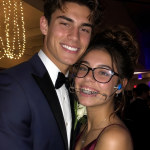
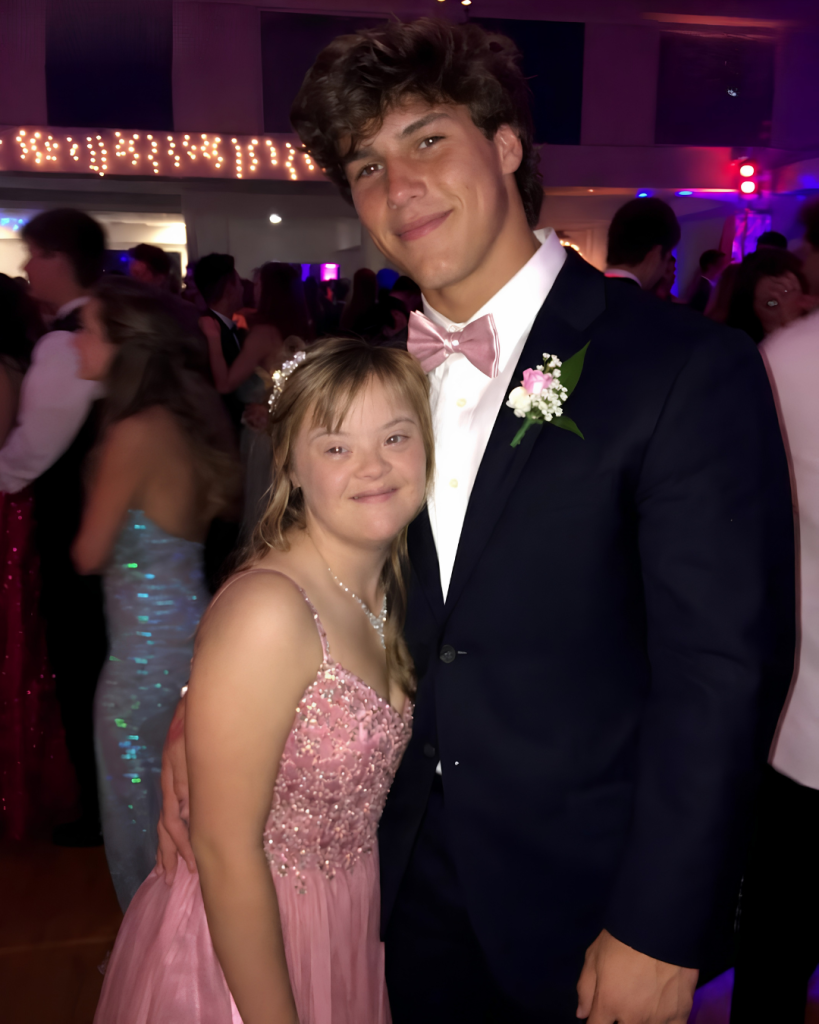
Now she was getting ready for prom.
And not just any prom.
The school’s star quarterback had asked her.
Steven Parker.
The name everyone in town knew.
Three weeks earlier, he had shown up at our door with a single white tulip in his hand.
He looked directly at Rosie.
“Would you go to prom with me?”
I was so stunned I answered first.
“Yes.”
Then I stepped aside so Rosie could speak for herself.
My sister Megan cried when she heard.
“She deserves this,” she said. “Let her be happy.”
I wanted to believe it.
I really did.
But something in me wouldn’t settle.
Why Rosie?
Why her?
What did he see that others didn’t?
The question stayed with me longer than I wanted to admit.
“Mom?”
Rosie had stopped dancing.
“You’re doing the worried face again.”
“What worried face?”
“The one where your eyebrows do that twisty thing.”
I let out a small laugh.
“Come on. Let’s get you ready.”
A few minutes later, I zipped up her pale blue dress and stepped back.
She looked beautiful.
Not because of the dress.
Not because of makeup.
Because she was glowing.
Because she was happy.
“You look like a princess,” I said.
Her eyes widened.
“Really?”
“Really.”
The gym that night looked like a fairytale. Lights sparkled overhead. Blue and silver decorations shimmered along every wall.
Then Steven arrived.
The entire room seemed to shift as he walked straight toward her.
He stopped in front of Rosie and gave a small bow.
“May I have this dance?”
Rosie lit up.
“Yes,” she whispered.
He took her hand gently.
The music started.
And they moved onto the floor together.
One-two-three, turn.
One-two-three, turn.
Exactly as she had practiced.
For the first time in days, I let myself think I might have been wrong.
Maybe he really was just a good kid.
Then I saw his jacket.
It had fallen over a chair near my table.
When I picked it up to return it, something hard pressed against the lining of the inside pocket.
A flash drive.
A thick bundle of photographs.
And a red envelope.
On it, four words were written in bold marker:
AFTER THEY LAUGH.
My stomach tightened.
I opened the photos.
The first showed Rosie crying in a bathroom stall.
The second showed her holding her torn jacket.
The third showed her sitting alone in the cafeteria.
My hands began to shake.
“Don’t.”
Steven’s voice came from behind me.
I turned.
He stood there, expression gone completely still.
“Put them back,” he said quietly.
“Why do you have these?”
“You need to trust me.”
“Trust you?”
His eyes didn’t move from mine.
“Please.”
“If this is some kind of joke—”
“It’s not.”
His voice was steady, almost heavy.
“Just wait.”
“If you hurt my daughter,” I said, “you’ll regret it.”
“I know,” he replied.
Then he walked away.
Not toward Rosie.
Toward the stage.
A cold panic spread through me.
I moved to follow him, but two football players stepped into my path.
“Please,” one said. “Just wait.”
“You don’t understand,” I snapped.
The taller one met my eyes.
“Actually… we do.”
Steven stepped onto the stage.
The music stopped.
The room fell silent.
“Everyone,” he said into the microphone, “I need you to listen.”
Rosie stood frozen near the dance floor.
He raised the flash drive.
“I was supposed to say something else tonight.”
He plugged it into the screen.
The first image appeared.
Rosie, alone in a bathroom stall, crying.
A gasp moved through the crowd.
“Steven,” I whispered.
Another image.
Her jacket torn.
Then another.
And another.
Each one showing a moment of cruelty she had tried to hide for years.
And then I saw something I hadn’t noticed before.
Faces.
The same students. Over and over.
Madison.
Brooke.
Caitlin.
Steven pointed at the screen.
“Everyone sees Rosie,” he said.
“But nobody sees what happens to her when no one is looking.”
Silence filled the gym.
“For two years, we watched this happen,” he continued.
“We asked them to stop.”
Another image.
“They laughed.”
Another.
“We warned them.”
Another.
“They laughed harder.”
The room had gone still.
Teachers. Parents. Students.
No one moved.
“So I started documenting it.”
He held up the red envelope.
“This is why it says ‘After They Laugh.’”
A few staff members were already moving toward the students shown on screen.
The atmosphere shifted completely.
The people who had hidden behind laughter and whispers suddenly had nowhere left to go.
Then Steven turned toward Rosie.
His voice softened.
“Rosie.”
She looked up.
“I owe you an apology.”
The room stayed silent.
“I should’ve shown you this sooner.”
Her confusion deepened.
“But I wanted everyone to see it at the same time.”
Her eyes filled with tears.
Steven stepped down from the stage.
And suddenly, I understood.
This wasn’t humiliation.
It was evidence.
It was protection.
He hadn’t brought her here as a prank.
He had brought her because he had seen what others refused to see.
He reached into his pocket and pulled out a small velvet box.
Rosie gasped.
Inside was a delicate silver bracelet with a tiny ballerina charm.
“The kind you wrote about,” he said quietly.
Rosie covered her mouth.
“I found your diary,” he admitted.
A few people shifted uncomfortably.
“I know I shouldn’t have read it. But I’m glad I did.”
He took her hand gently.
“You said you wanted to dance without anyone laughing.”
The bracelet caught the light.
“You said you wanted to be brave like a ballerina.”
Tears streamed down her face.
Steven fastened it around her wrist.
“Tonight,” he said, “everyone is going to watch you dance.”
He paused.
“And nobody is going to laugh.”
For a moment, no one moved.
Then applause broke out.
It started small, then grew, until the entire gym was standing.
Rosie looked around, stunned.
“Mom,” she whispered.
I stepped forward.
“He saw me.”
And she was right.
He had.
Not her diagnosis.
Not the label the world had given her.
Her.
I turned to Steven.
“I was wrong,” I said quietly.
“I thought you were going to hurt her.”
“You’re her mother,” he said gently. “You were protecting her.”
“Thank you.”
He gave a small smile.
“She made it easy.”
The music started again.
He offered his hand.
“May I have this dance?”
Rosie laughed through tears.
“Yes.”
They stepped back onto the floor.
One-two-three, turn.
One-two-three, turn.
Exactly as she had always dreamed.
And as I watched them move under the lights, I realized how long I had lived expecting the worst.
How carefully I had learned to watch for cruelty.
How deeply I had trained myself to protect her from the world.
But I had forgotten something.
Not everyone looks away.
Not everyone hurts.
Sometimes, kindness shows up quietly.
Sometimes it carries a white tulip.
And sometimes, it refuses to let a child’s pain stay hidden.
That night, Rosie danced like she had always imagined.
And for the first time in a long time, I let myself believe the world could hold both danger—and good people willing to stand against it.