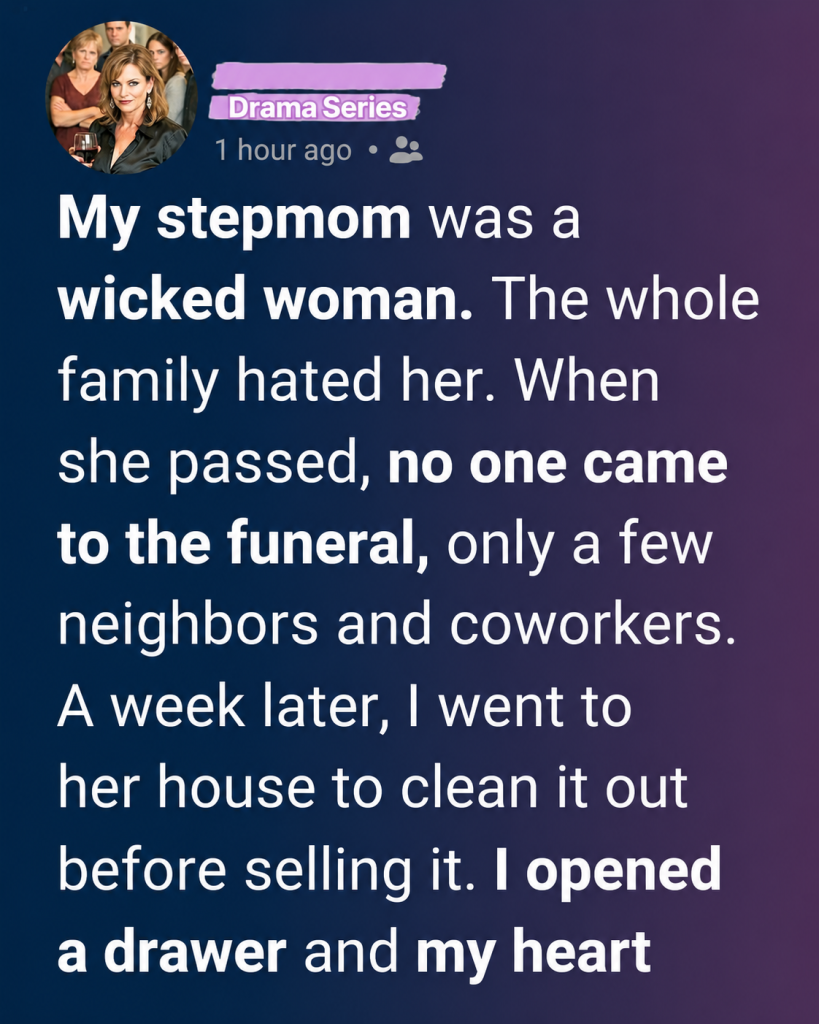

When my stepmother, Eleanor, died, the house seemed strangely untouched by grief.
There were no casseroles crowding the kitchen counters. No steady stream of relatives filling the driveway with solemn faces and whispered condolences. At her funeral, fewer than a dozen people attended—three neighbors, two women from her office, the pastor, and me. Even my father’s siblings, who had spent years criticizing her, stayed away.
To most of the family, Eleanor had always been the villain.
They called her cold, calculating, and controlling.
“She never smiles unless it’s convenient,” my aunt once muttered during Thanksgiving dinner.
“She only married your father for security,” my cousin insisted more than once.
Even I kept my distance. Eleanor wasn’t the kind of person who made people feel instantly welcome. She rarely hugged anyone. She disliked small talk. She corrected grammar at the dinner table and organized the pantry with military precision.
After my father died, she became even more withdrawn. She handled legal paperwork alone, refused help with repairs, and declined nearly every family invitation.
“She thinks she’s better than us,” people said.
Maybe we believed it because it was easier than asking what burdens she carried.
A week after the funeral, I went to her house to prepare it for sale. The silence inside felt almost deliberate. Everything was immaculate—floors polished, curtains freshly washed, documents neatly arranged in labeled folders. It was exactly how Eleanor had always lived.
While sorting through her bedroom dresser, I opened the bottom drawer and found several small wooden boxes lined up in perfect order.
Each box had a name written on it in Eleanor’s unmistakable handwriting.
My heart skipped.
There was one for my aunt. One for my cousin. One for my brother.
And one for me.
For a moment, I simply stared at my box, remembering years of awkward conversations, strained holidays, and long stretches of silence between us.
Then I opened it.
Inside were two pieces from her heirloom jewelry collection—valuable antiques I recognized from arguments that had erupted years earlier. Beneath them was a check made out to me for $20,000.
I sat down on the edge of the bed, stunned.
None of it made sense.
Eleanor had always been accused of favoritism and secret grudges. Yet here was my name written with the same careful attention she had given everyone else.
I immediately called the family.
The first reactions were suspicious.
“What do you mean there’s a box for me?” my cousin demanded.
“Are you sure that isn’t just yours?” my aunt asked.
“Open it,” I told them. “Just open it.”
One by one, they did.
And one by one, disbelief replaced suspicion.
Every box was identical.
The same amount of money.
The same number of heirloom pieces, carefully selected to match in value.
Everything had been divided equally, as though she had spent months planning every detail.
There was no favoritism.
No hidden advantage.
No secret conditions.
Just fairness.
As I returned the boxes to the drawer, I noticed a folded sheet of paper tucked underneath them.
I unfolded it carefully.
The handwriting was firm and precise, exactly as I remembered.
“Don’t bite each other while splitting my things. I already took care of your share. I hope you’ll take care of mine.”
Below the message was a short list.
White lilies.
Blue irises.
No roses.
Replace them every spring.
That was all she asked.
No grand memorial.
No dramatic speeches.
No monument.
Just flowers.
I sat there holding the note for a long time.
We had expected arguments. Competition. Resentment. We had already imagined the inevitable fights over money and jewelry.
Eleanor must have known that.
She knew our weaknesses. She knew our impatience.
So she removed every opportunity for conflict before it could begin.
She had taken responsibility for fairness so that we would not tear each other apart.
In that moment, something inside me changed.
I thought about all the habits we had mocked throughout the years—the balanced portions at dinner, the saved receipts, the endless lists and careful records.
We called it controlling.
Now I saw it differently.
She wasn’t controlling.
She was careful.
She wasn’t cold.
She was disciplined.
She never needed approval, so she never tried to win people over with charm. She chose responsibility over popularity, order over appearances. Because she never softened herself to make others comfortable, we cast her as the villain in our family story.
It was easier than trying to understand her.
The following weekend, more relatives gathered at her grave than had attended her funeral.
Each of us carried white lilies and blue irises.
No one said much.
There were no spoken apologies, but there was a quiet understanding among us. The resentment that had lingered for years had been replaced by something heavier.
Regret.
Eleanor spent most of her life being misunderstood.
Yet in the end, she revealed herself to be the most thoughtful and fair-minded person among us.
She never demanded affection.
She never asked for forgiveness.
She simply fulfilled her responsibilities—even after death—with the same steady dedication she had shown throughout her life.
As I placed my flowers beside the others, I realized something I will never forget:
Sometimes the people we judge most harshly are the ones carrying the deepest sense of duty. And sometimes wisdom doesn’t arrive wrapped in warmth. Sometimes it appears as fairness, order, and quiet responsibility.
We misunderstood Eleanor.
But she understood us perfectly.