
Years ago, before the stable career and comfortable paycheck, I worked as a server in a busy downtown restaurant. I spent long days on my feet, living paycheck to paycheck and relying on tips to cover rent, groceries, and whatever bills couldn’t wait.
One particularly busy Tuesday night, a well-dressed man walked into my section and sat alone at Table 12.
From the moment he arrived, something felt different.
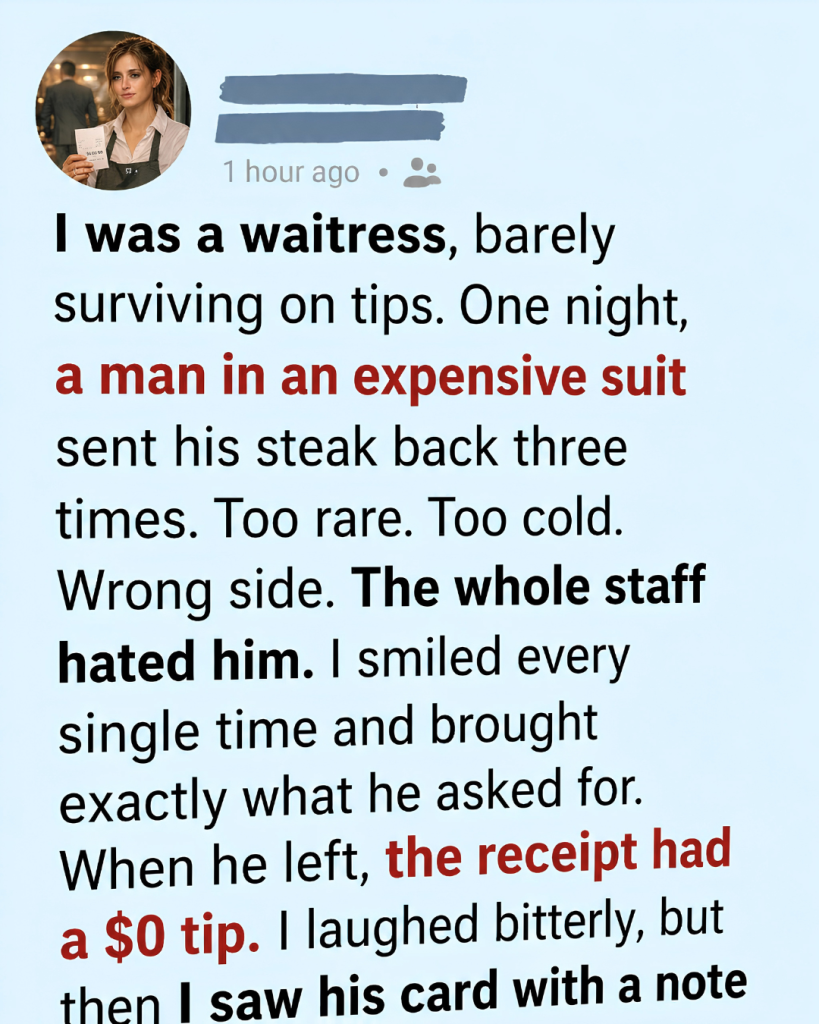
He ordered a medium-rare steak and a baked potato. Simple enough. But when I brought out the meal, he immediately sent it back.
“It’s too rare,” he said.
I apologized and returned it to the kitchen. The chef prepared another steak without complaint.
When I brought the replacement, the customer frowned again.
“It’s too cold.”
Back to the kitchen I went.
By now, the staff had started noticing.
“He’s testing you,” one of the cooks said. “Nobody sends back that many perfectly good meals.”
Maybe he was right. But I kept smiling.
The third plate came out.
“The sides are wrong,” the man said.
I knew they weren’t. I had checked them myself.
Still, I apologized, took the plate, and returned to the kitchen once again.
The chef looked ready to lose his patience.
“Tell him to order the menu himself,” he joked.
But I simply asked for another correction and carried on.
For nearly two hours, the pattern continued. Tiny complaints. Constant requests. Nothing was ever quite right.
Yet I stayed polite.
Not because I enjoyed it. Not because I expected a big tip.
Because professionalism means treating people well even when they don’t make it easy.
Eventually, the restaurant began to empty. The man finished his meal and asked for the check.
I dropped it off and returned a few minutes later.
The bill was paid.
The tip line was blank.
My heart sank.
After everything, not even a dollar.
As I picked up the folder, a folded note slipped onto the table.
Curious, I opened it.
Inside was a business card.
The man wasn’t just a customer.
He owned a regional restaurant group with dozens of locations.
Written on the card was a short message:
“Most people are kind when things go well. Character is revealed when things don’t. Call me tomorrow.”
The next morning, I did.
He invited me to his office and explained everything.
He wasn’t testing my ability to carry plates or memorize orders. He was looking for someone to manage people, solve problems, and remain calm under pressure.
“I watched how you handled frustration,” he said. “You never blamed the kitchen. You never argued. You never embarrassed me. That’s harder to teach than any business skill.”
A week later, he offered me my first management position.
That opportunity changed the direction of my life.
Looking back, I realize the lesson wasn’t really about restaurants. It was about how we carry ourselves when nobody is rewarding us for doing the right thing.
Sometimes the moments that feel most unfair are quietly preparing us for something bigger. And sometimes, the people who challenge us the most end up opening doors we never expected.