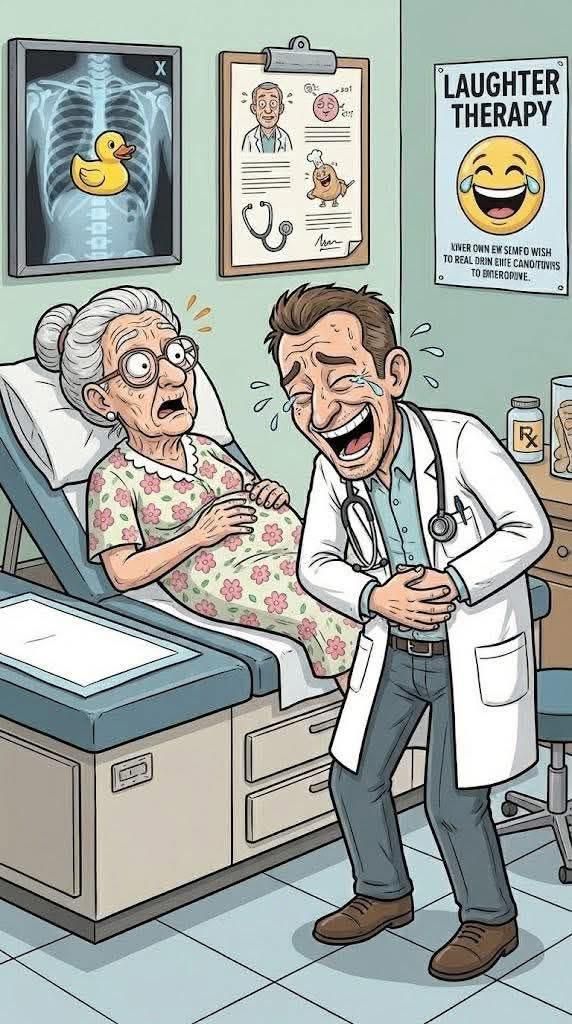

The nurse heard her scream through the door.
Not the kind of scream that demands attention in a busy clinic—no collapse, no sirens—but the sharp, wounded sound of someone realizing she is being mocked instead of helped. Inside the examination room sat an elderly woman clutching her handbag to her chest, shoulders stiff, jaw set, already preparing herself for the familiar dismissal.
It had happened twice before.
Two doctors had barely concealed their amusement. Before a full exam, before careful questions, they arrived at the same crude conclusion. They laughed. They made jokes. They prescribed ointments meant for something she insisted could not be the cause. Each time she told them the same thing—that she was eighty years old, that she had never been sexually active, that she knew her own body well enough to say something was wrong—they waved her off.
“Crabs,” they said, with smirks that made her feel small.
She left those appointments burning with more than irritation. The itch remained, but so did the humiliation. It settled somewhere deeper, alongside a lifetime of silence about her body, her loneliness, her belief that at her age, she no longer had the right to be taken seriously.
By the time she arrived at the third clinic, she was ready for another dismissal. She sat upright, handbag tight in her grip like armor, prepared to endure the same ritual again. But this time, something changed.
The doctor did not rush.
He did not joke. He did not assume. He listened.
He asked questions slowly, without embarrassment or condescension. He examined her carefully. He treated her not as a punchline, but as a woman who had lived a full life—one marked by restraint, modesty, and a silence shaped by a generation that was never taught to speak openly about discomfort, especially not this kind.
The diagnosis was simple. Ordinary. Easily treated. Nothing remotely like what the others had claimed.
What stunned everyone was not the medical discovery, but the contrast.
There was no laughter this time. No raised eyebrow. No impatience. Just respect.
When he explained the condition and the treatment, his voice carried something she had not heard in years: dignity. He spoke to her as though her age did not erase her humanity, her story, or her right to care. When she left the clinic, prescription in hand, she realized the medicine was only part of what she had been given.
She had been believed.
For decades, she had learned to make herself smaller, quieter, less demanding. She had accepted that certain discomforts were simply the price of growing old. That day, she understood how much damage had been done not by illness, but by indifference.
The crude joke had never been the worst part.
The worst part was being treated as though her body—and her suffering—no longer mattered.
That final doctor did not perform a miracle. He did something far rarer: he listened. And in doing so, he reminded her that care is not just about diagnosis. It is about seeing the person in front of you, no matter their age, their history, or how uncomfortable their story makes you.
Sometimes, what heals most is not the treatment itself—but the moment someone finally takes you seriously.